
Blog

What Are the 10 Best Solar Water Purification Systems?

Solar Water Purification is not one device, but a family of approaches. It includes sunlight-driven disinfection, solar distillation, and photovoltaic systems powering filters or ultraviolet treatment. Each solves a different problem. A clear bottle in bright sun may reduce certain pathogens, while a distiller can separate many dissolved substances. Neither should be assumed to remove every contaminant.

The need is substantial. The WHO/UNICEF Joint Monitoring Programme reported that 2.2 billion people lacked safely managed drinking-water services in 2022. That figure makes small-scale treatment worth examining, but it does not make every solar product suitable. Water source, daily output, cloud cover, storage, and maintenance all matter. So does independent testing.

Water-treatment researcher Dr. Thomas Clasen’s published work emphasizes evaluating household treatment under real-world conditions. A concise paraphrase of that principle is: “A treatment method must work reliably in everyday use.” That is a useful test for this guide’s ten leading systems. A glossy panel is not proof. Look for validated contaminant-removal claims, clear capacity data, replaceable parts, and practical cleaning instructions. Consider the tap, too. How much water does a household actually need each day? Some systems also require pretreatment or a backup source during cloudy weather. The comparison that follows weighs performance, usability, cost, and limits. Solar power can help. It is not a guarantee of safe water.
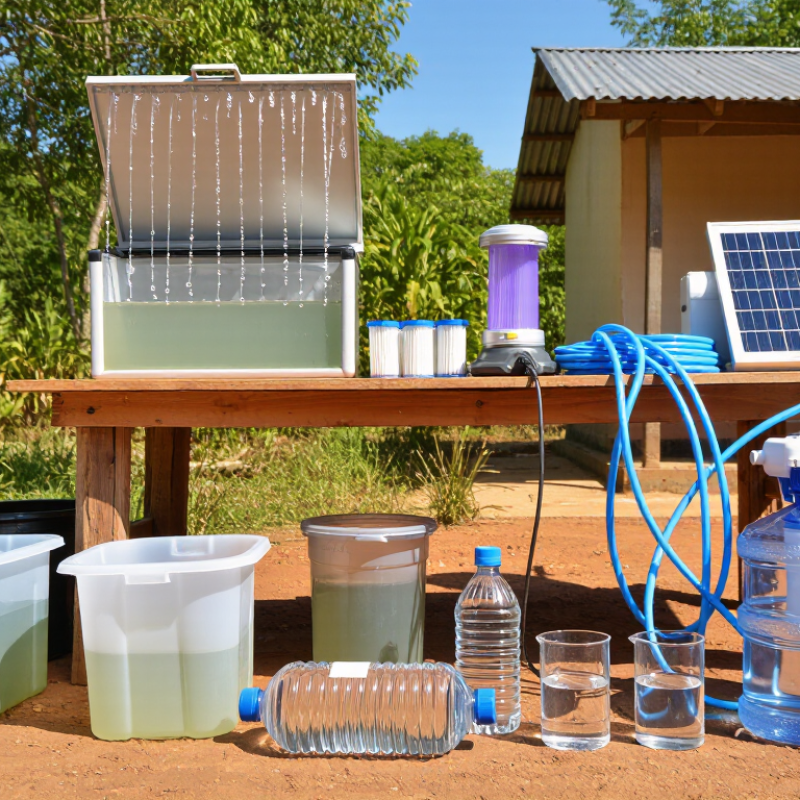
What Are the 10 Best Solar Water Purification Systems?

How Solar Water Purification Systems Remove Contaminants

Solar water purification removes contaminants through heat, light, or powered treatment—not one universal process. Solar stills warm water until it evaporates, then collect condensed droplets. Salts, sediment, and many microbes remain behind because they do not evaporate with the water. But some volatile chemicals may travel with vapor, so distillation does not address every contaminant. Solar ultraviolet treatment damages microbes’ ability to reproduce. It does not remove dissolved chemicals, metals, or dirt.

System performance depends on the source water and operating conditions. UV treatment needs relatively clear water and enough exposure; clouds, shading, or a dirty lamp can reduce effectiveness. Some systems pair solar electricity with sediment or carbon filters. Those filters target different problems and need timely replacement. The part users often underestimate is maintenance. A clogged prefilter or poorly sealed collection vessel can undo careful treatment. For uncertain water, testing the treated sample is more dependable than judging it by taste or appearance.

Tips: Let muddy water settle, then prefilter it before UV treatment. Keep collection containers clean and covered. Follow the system’s exposure and maintenance instructions, and verify results with appropriate water testing. A small routine matters.

What to Consider When Comparing Solar Water Purifiers

When comparing solar water purifiers, check which contaminants each system is designed to reduce. Solar disinfection, ultraviolet treatment, and solar distillation work differently. A device that targets microbes may not remove dissolved metals, salts, or fuel residues. WHO household water-treatment guidance emphasizes proper operation and suitable water quality. WHO and UNICEF’s 2023 Joint Monitoring Programme estimated that 2.2 billion people lacked safely managed drinking water in 2022. That scale makes clear performance information essential.

Compare verified pathogen-reduction results, daily output, and performance in cloudy conditions. A system may produce enough water at noon but too little for a family by evening. Check whether cloudy water needs pre-filtration, and whether the unit includes safe storage. Solar distillation can reduce many dissolved contaminants, but output may be modest. PV-powered treatment can be more convenient, yet depends on panels, batteries, and replacement parts. A spec sheet can still flatter a system. Test results matter more. Look for independent testing and clear limits, not vague claims such as “purifies everything.”

Tips: Estimate your household’s daily water needs, then compare them with tested output. Ask what happens after two cloudy days. Inspect seals, filters, and storage containers; small leaks can undo good treatment. When in doubt, have questionable water tested before choosing a system.

What Are the 10 Best Solar Water Purification Systems? - What to Consider When Comparing Solar Water Purifiers

System Type How It Works Best Suited For Typical Practical Output What It Can Treat Main Considerations
Solar water disinfection (SODIS) Sunlight inactivates disease-causing microorganisms in clear water held in suitable transparent bottles. Small household or emergency drinking-water batches where sunlight is strong and water is relatively clear. One bottle-sized batch at a time; commonly up to about 2 L per bottle. Can inactivate many bacteria, viruses, and protozoa when exposure guidance is followed. Does not remove salts, metals, or chemical pollutants. Turbid water should be clarified first. Common guidance is about 6 hours in strong sun, or two consecutive days in cloudy conditions.
Solar thermal batch pasteurizer A solar collector heats water in a covered container to a pasteurization temperature; a temperature indicator can help confirm heating. Households needing batch treatment without electricity. Batch-sized; volume depends on collector area, sunlight, starting temperature, and container design. Heat can inactivate many disease-causing microorganisms. Does not remove dissolved chemicals or salts. Heating requirements and indicator use matter; treated water must be stored safely to prevent recontamination.
Single-basin solar still Solar heat evaporates water from a basin; vapor condenses on a cooler cover and runs into a collection channel. Small volumes of fresh water from salty or contaminated source water in sunny locations. Usually low and weather-dependent; often discussed in liters per square meter of still area per day, with actual yield varying substantially. Distillation can separate microbes and many nonvolatile dissolved substances, including salts. Output is generally modest. Some volatile chemicals may carry over with the vapor; maintenance and careful collection are needed.
Wick solar still A dark, absorbent wick spreads a thin layer of water to increase the surface area exposed to solar heat. Small-scale use where a simple still is desired and the feed water can be supplied evenly to the wick. Low, variable output; depends on sunlight, wick area, humidity, and design. Uses evaporation and condensation, so it can separate microbes and many nonvolatile dissolved substances. Wicks need cleaning or replacement, and output remains weather-dependent. Volatile contaminants may not be reliably removed.
Multi-effect solar distillation Heat from one evaporation stage is reused in additional stages to recover more fresh water from the same solar heat input. Small community or facility-scale projects with consistent sun and space for a larger installation. Design-specific; generally greater potential output than a basic still, but no single capacity applies across systems. Distillation can reduce microbial contamination and many dissolved salts and nonvolatile substances. More components and controls than a basic still. Output, cost, and maintenance depend heavily on design; volatile compounds may require additional treatment.
Photovoltaic-powered UV disinfection Solar panels power a UV lamp or UV reactor that inactivates microorganisms as water flows through it. Clear, low-turbidity water where a reliable solar-electric supply is available. Continuous flow is possible; treatment rate depends on the reactor rating, water clarity, and available power. Can inactivate many microorganisms when the required UV dose reaches the water. Does not remove salts, metals, or most chemicals and leaves no disinfectant residual. Turbidity can shield microbes; lamps and electrical components require maintenance.
PV-powered ceramic filtration with disinfection A small solar-powered pump moves water through a ceramic filter, followed by a suitable disinfection step when needed. Household use where water contains visible particles and the user can clean the filter and manage disinfection. Low to moderate flow; depends on filter area, pump power, clogging, and cleaning frequency. Ceramic filtration can reduce particles and many bacteria and protozoa; performance against viruses varies. A separate disinfection step adds microbial protection. Filtration alone should not be assumed to remove viruses or dissolved contaminants. Filter integrity, cleaning, and the follow-up disinfection method are important.
PV-powered ultrafiltration A solar-powered pump pushes water through a membrane that retains suspended particles and many microorganisms. Households or small facilities needing treated water from surface water or other particle-containing sources. Low to moderate flow; varies with membrane area, pressure, feed-water quality, and power availability. Can remove suspended solids and many bacteria and protozoa. Virus removal depends on membrane rating and system validation. Does not desalinate water or reliably remove dissolved chemicals. Pretreatment and periodic membrane cleaning may be needed; a validated disinfection step may be appropriate.
PV-powered reverse osmosis Solar electricity powers a pump that forces water through a semipermeable membrane. Brackish water or other sources requiring substantial reduction of dissolved salts. System-specific; production depends on membrane size, pressure, water temperature, and solar power. Can reduce dissolved salts and many other dissolved substances, as well as microorganisms, when properly designed and maintained. Requires pretreatment and membrane care. Produces a concentrated reject stream that must be managed; not every chemical is removed equally.
PV-powered electrodialysis or electrodialysis reversal Electric fields move dissolved ions through selective membranes to reduce salinity. Brackish water with moderate salinity, particularly where ion removal is the main treatment need. System-specific; depends on feed-water salinity, treated volume, membrane stack, and available power. Primarily removes dissolved ions; it is not a stand-alone microbial disinfection method. Less suited to seawater than many reverse-osmosis designs. Requires management of a concentrate stream and a separate microbial treatment barrier where needed.

Comparison note: “Best” depends on the source water, required daily volume, local sunlight, maintenance capacity, and contaminants of concern. Output figures are design- and climate-dependent; test source water and verify that the chosen treatment is suitable for its specific risks.

Ten Notable Solar Water Purification Systems Compared

A useful comparison starts with the water source and the contaminants involved. Basin solar stills and wick stills evaporate water, then collect condensed droplets; wick designs can expose more water to sunlight. Solar thermal pasteurizers heat water to a validated temperature and holding time. Bottle-based solar disinfection uses sunlight to reduce pathogens in clear water, while solar-powered UV reactors deliver controlled ultraviolet treatment. They do not remove dissolved chemicals. Important distinction.

PV-powered reverse-osmosis units can reduce salts and many dissolved contaminants, but need pretreatment and produce a concentrated reject stream. Solar membrane-distillation systems use heat to move water vapor across a membrane, though scaling can reduce output. PV-powered ultrafiltration targets particles and many microbes, but not salts or all dissolved chemicals. Solar photocatalytic systems use light and reactive materials to break down selected pollutants; performance depends on careful testing.

These ten approaches differ in output, maintenance, and what they can reliably remove. A still may yield only a small amount on a cloudy day. Filters need replacement, and UV methods need sufficiently clear water. Check independent test results for the specific source water, not just broad claims. A simple field check helps, but it cannot confirm safety. Some designs look elegant on paper; real-world performance can be less tidy.

Choosing a System for Home, Travel, or Emergency Use

Choosing among the 10 best solar water purification systems starts with the setting, not the panel size. For a home, compare daily output, tested contaminant reduction, replacement-filter access, and whether the unit works during cloudy weather. Solar-powered UV systems need reliable electricity and usually clear, prefiltered water; solar distillers can reduce many dissolved contaminants, but output may be slow. Check independent test results for the specific microbes and chemicals you need to address. “Solar” alone is not proof of safety.

Travel changes the priorities. A compact system should fit your pack, treat water quickly, and have a workable backup when sunlight disappears. Simple sunlight disinfection is not a catch-all: cloudy skies, turbid water, and bottle size affect performance. At home, a fixed system with covered storage may be more practical. For emergencies, consider stored treated water alongside the purifier; the CDC advises at least one gallon per person per day for three days. That supply runs out fast. The WHO/UNICEF Joint Monitoring Programme reported that 2.2 billion people lacked safely managed drinking water in 2022. When comparing models, calculate household demand in liters per day, then check real-world output, maintenance needs, and performance under weak sunlight. I would still plan for a non-solar backup; weather rarely follows a checklist.

10 Solar Water Purification System Types: Treatment Coverage

A general comparison of whether each treatment type can address four common contaminant groups.

A value of 1 means the method can generally address that group when correctly designed and operated; 0 means it is not reliable as a sole treatment. Actual performance depends on the device and water conditions. Filtration and UV systems typically require clear water, and this chart does not assess chemical contaminants beyond dissolved salts.

Maintenance Needs and Water Safety Checks

Solar water purification systems need regular care, even when they have few moving parts. Dust on a panel can reduce power, while sediment may clog a prefilter. Wipe the panel with a soft cloth and inspect hoses, seals, and fittings for cracks or slow leaks. Clean or replace filters according to the system’s instructions, not just when water flow drops. That delay is easy to miss.

Keep a simple maintenance log. Dates help reveal patterns. After cleaning or replacing parts, flush the unit as directed and check the treated water. Clear water is not necessarily safe; harmful microbes may be invisible. Use an appropriate water test, especially after repairs, heavy rain, flooding, or a change in source water. For uncertain results, consult a qualified laboratory or local water specialist. I would not rely on taste or smell alone. They can flag a problem, but they cannot confirm safety. Follow the system’s specific guidance for disinfection and testing, since solar designs differ. A missed check can happen, so set a recurring reminder and record what you actually inspected.

By continuing to use the site, you agree to the use of cookies. more information

The cookie settings on this website are set to "allow cookies" to give you the best browsing experience possible. If you continue to use this website without changing your cookie settings or you click "Accept" below then you are consenting to this.

Close