
Choosing reliable Quartz Rods suppliers in 2026 requires more than comparing catalog prices. Global buyers need consistent purity, accurate dimensions, stable thermal performance, and dependable export service. Quartz rods support laboratory furnaces, semiconductor processing, optical equipment, UV systems, and high-temperature manufacturing. Each application demands different specifications. Clear requirements matter.
This guide examines leading suppliers through practical purchasing criteria. These include fused silica quality, diameter tolerance, surface finish, hydroxyl content, packaging, and production capacity. Supplier experience also matters. A manufacturer serving laboratories may not meet semiconductor-grade expectations. Request recent inspection reports, material certificates, sample pieces, and batch-traceability records before placing a large order. Ask how rods are protected against scratches and moisture during international transport. Small details can become expensive problems.
A credible supplier should explain testing methods, expected tolerances, lead times, and after-sales procedures without vague promises. Certifications can support trust, but certificates alone do not prove consistent performance. Independent verification remains useful. Published specifications may not reflect every production batch. That is worth remembering.
The strongest 2026 suppliers will combine technical knowledge with responsive communication. They should help buyers select suitable diameters, lengths, grades, and machining options. Pricing is important, but rejection rates and delivery delays can cost more. Buyers should compare total landed cost, not only the unit quotation. Some rankings may change as capacity, energy costs, and regional logistics shift. This guide therefore offers a practical starting point, not a permanent verdict.
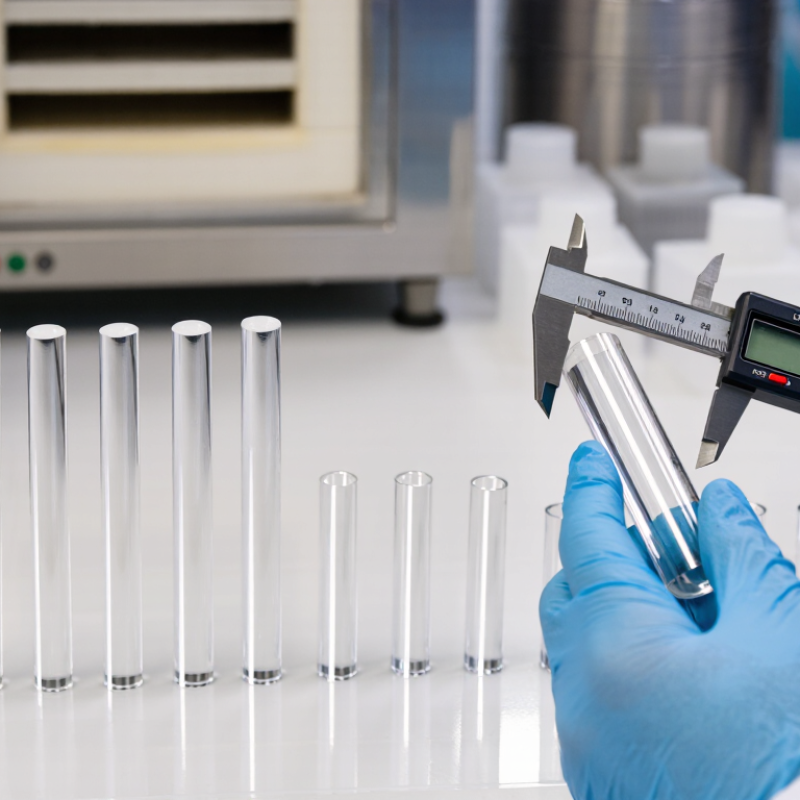
Quartz rods are cylindrical components made from high-purity fused silica, or silicon dioxide. They tolerate rapid heating, strong ultraviolet light, and many corrosive chemicals. Unlike ordinary glass, fused silica contains very low levels of alkali impurities. That matters in clean processing.
Laboratory users employ quartz rods for stirring, support frames, furnace fixtures, and custom apparatus. Semiconductor plants use them in diffusion, oxidation, and wafer-cleaning equipment. They also appear in optical, photovoltaic, and lighting applications. SEMI’s 2024 World Fab Forecast tracked more than 1,400 semiconductor facilities and production lines worldwide, showing the scale of equipment demand around quartzware. The connection is indirect, but important.
Specifications determine performance. Buyers should check purity, hydroxyl content, diameter tolerance, surface finish, and maximum service temperature. A rod for laboratory heating may not suit a high-temperature process chamber. The wrong grade can release particles or deform. Small details matter.
The U.S. Geological Survey’s Mineral Commodity Summaries identifies industrial silica as a major material supporting glass, foundry, and high-technology manufacturing. However, public reports rarely separate quartz rods from broader silica categories. This creates a measurement gap. Suppliers should provide inspection records, dimensional data, and traceability instead of relying only on market claims. In practice, many failures begin with unclear drawings. A careful buyer should also confirm thermal shock requirements, packaging methods, and the intended atmosphere before comparing global suppliers.
2026 Top Quartz Rods Suppliers for Global Buyers?
In practical procurement, quartz rod selection starts with chemistry, not catalog photos. Ask for fused silica grade, SiO2 purity, hydroxyl content, and the intended operating temperature. Low OH material can reduce infrared absorption, while high-purity material supports demanding laboratory and semiconductor processes. Confirm diameter, length, straightness, and tolerance in millimeters. A rod that looks uniform may still fail a tight assembly.
Surface finish needs equal attention. Request roughness data, edge condition, and inspection criteria. For furnace use, compare thermal expansion, softening point, and resistance to repeated heating. For optical or analytical equipment, ask about bubbles, striae, inclusions, and transmission data. Reliable suppliers should provide batch numbers, certificates, dimensional reports, and clear packaging details. Wooden cases, separators, and moisture protection can prevent chips during ocean transport. I have seen excellent rods arrive damaged because packaging was treated as an afterthought. That lesson is easy to underestimate.
Tips: Send a dimensioned drawing, usage temperature, and annual demand before requesting quotations. Test a small sample under real heating conditions. Measure it again. Compare at least three offers using the same specification sheet. Ask suppliers to explain any missing value, rather than accepting a polished but incomplete certificate. My own checklist is never perfect; field conditions often reveal one overlooked detail.
Global buyers need more than a low quotation when selecting quartz rod suppliers. The 2024 USGS Mineral Commodity Summaries reported roughly 100 million metric tons of industrial sand and gravel production in the United States during 2023. However, only a specialized portion becomes high-purity fused quartz. This distinction matters. Ask suppliers to disclose raw material grade, hydroxyl content, metallic impurities, bubbles, and visible striae.
SEMI’s 2024 World Fab Forecast indicates continued semiconductor capacity expansion through 2026. That growth supports demand for quartz components used near high-temperature processes. Reliable suppliers should provide dimensional tolerances, thermal-shock data, inspection records, and traceable batch numbers. A practical trial can include 10 to 20 rods, followed by microscopy and thermal cycling. Measure straightness too. It is often overlooked.
Price comparisons can mislead. Packaging quality, export experience, and replacement response affect the real cost. I would request samples before signing a yearly contract. A polished certificate is not proof of stable production. Suppliers claiming ISO 9001 control should still explain furnace cleaning, annealing, and final inspection procedures. The International Trade Centre’s trade data also shows how transport distance and customs classification influence landed costs for glass and silica products. Some procurement teams ignore this. They later discover that a cheaper rod becomes expensive after breakage, delays, or inconsistent purity.
For global buyers, quartz rod sourcing should begin with evidence, not polished promises. A reliable supplier explains raw material selection, melting controls, and dimensional inspection. Ask for recent test reports covering SiO2 purity, hydroxyl content, diameter tolerance, and surface defects. Request samples from the same production line used for your order. A beautiful sample can hide weak process control. Record its clarity, straightness, surface condition, and break resistance during handling. In my experience, small visual flaws often become costly failures in high-temperature assemblies.
Certifications deserve careful checking. Confirm the issuing body, certificate scope, expiry date, and tested product range. ISO 9001 may indicate documented procedures, but it does not prove every rod meets your specification. For laboratory, lighting, or semiconductor applications, request traceability records and batch-level inspection data. Production capacity also needs practical proof. Review furnace size, operating schedules, monthly output, lead times, and backup equipment. Ask how urgent orders are handled without mixing batches. Capacity claims are easy to inflate. Purchase records or anonymized delivery evidence may provide a clearer picture. Documents can still be incomplete, so your risk plan should reflect that.
Tips:
Compare at least three suppliers using one specification sheet. Arrange a video audit or independent inspection. Check packaging, moisture protection, labels, and export documents before shipment. Leave room for tolerance discussions. Perfect certainty is unrealistic.
International buyers should treat quartz rod purchasing as a technical project, not a simple price comparison. Confirm diameter, length, purity, surface finish, straightness, and working temperature before requesting quotations. Ask suppliers for recent inspection records and clear tolerance data. A small diameter error can affect heating performance or laboratory assembly. Samples are useful, but one sample cannot represent every production batch. That limitation deserves attention.
Tips: Send a written specification sheet. Request photos of packed rods before dispatch. Confirm production time, packing method, shipping term, and insurance responsibility. Use strong tubes, protective caps, and shock-resistant filling. Include commercial invoices, packing lists, origin details, and accurate product descriptions. Customs delays often begin with incomplete paperwork. Keep every approval in email records.
After-sales support should be agreed before payment. Ask how damaged, incorrect, or short shipments are handled. A reliable supplier should provide a response period, evidence requirements, and a replacement or refund process. Buyers should inspect cartons immediately after arrival and record visible damage with photographs. For fragile quartz rods, hidden cracks may appear after unpacking. The inspection window must be practical, not merely written. It is also wise to confirm technical support for installation and cleaning. Some suppliers answer quickly before payment, then respond slowly afterward. That possibility should shape the final purchasing decision.
| Supplier Profile | Typical Product Focus | Common Purity Range | Typical Diameter Range | Available Surface Finish | Typical MOQ | Indicative Production Lead Time | Customization Capability | Quality Documents to Request | Common Export Terms | Shipping Considerations | After-Sales Expectations |
|---|---|---|---|---|---|---|---|---|---|---|---|
| Profile A High-purity fused quartz specialist | Laboratory, semiconductor-support, optical, and high-temperature applications | 99.95%–99.99% SiO2, depending on grade and process | Approximately 1–100 mm; tighter tolerances normally require quotation | Clear Opaque Ground Polished | Usually 10–50 pieces for standard sizes; custom lots may be higher | 2–5 weeks for standard items; 4–8 weeks for engineered items | Cut-to-length, diameter control, end finishing, drilling, grooving, and drawing-based production | Certificate of analysis, dimensional inspection report, surface-finish results, packing list, and commercial invoice | EXW, FOB, FCA, and CIF are commonly available; confirm responsibility for export clearance | Protective individual sleeves, rigid cartons or wooden cases, moisture control where required, and shock-resistant packing | Written claim procedure, replacement or credit evaluation for verified defects, and technical clarification during installation |
| Profile B Industrial quartz-processing supplier | Heating equipment, chemical processing, furnaces, lighting, and general industrial assemblies | Typically 99.5%–99.99% SiO2, depending on the intended application | Approximately 3–150 mm, with larger sizes generally subject to tooling and availability | Transparent Translucent Machined | Commonly 25–100 pieces for standard products; negotiated for repeat orders | 3–6 weeks; production may be longer during peak periods or for large diameters | Length cutting, chamfering, threading, grooves, holes, and matched sets based on technical drawings | Material specification, dimensional report, visual inspection record, packing photos, and country-of-origin documentation | FCA, FOB, CFR, and CIF; DAP or DDP may be possible through a logistics partner | Compare freight quotations by chargeable weight and carton volume; confirm whether rods require special-length handling | Recommended response target of 1–3 business days for order issues, with defect evidence and batch traceability requested |
| Profile C Custom fabrication and prototyping supplier | Small-batch components, research equipment, prototype assemblies, and non-standard geometries | Usually specified by the selected raw material grade; confirm impurity limits before ordering | Often available from approximately 2 mm upward; maximum size depends on equipment and geometry | Polished Fire-polished Ground Etched | 1–10 pieces may be accepted for prototypes; unit pricing is usually higher | 3–8 weeks, including drawing review, tooling, fabrication, and inspection | High flexibility for drawings, tight dimensional tolerances, special end shapes, and integrated features | Approved drawing, inspection report, material declaration, photos before shipment, and revision-controlled documentation | EXW, FCA, and CIP are often practical for small consignments; agree on insurance coverage in writing | Use tubes or rigid cases with end protection; request a pre-shipment inspection for fragile or high-value parts | Technical review of nonconformities, drawing revision support, and remake or rework terms defined in the purchase order |
| Profile D High-volume standard-size manufacturer | Routine industrial consumption, replacement parts, and recurring production programs | Often 99.5%–99.99% SiO2; verify grade consistency between batches | Common standard sizes, frequently approximately 5–80 mm | Clear Standard-cut Polished ends | Typically 100–500 pieces, with better pricing at scheduled volumes | 2–4 weeks for stocked or repeat sizes; 5–8 weeks for new production schedules | Limited customization for standard products; length, packaging, labeling, and tolerances may be negotiated | Batch certificate, dimensional sampling plan, quantity verification, export documents, and carton labeling record | FOB, FCA, CFR, and CIF are commonly used for containerized or consolidated shipments | Consolidated freight can reduce cost; confirm carton count, gross weight, loading method, and breakage allowance | Formal replacement policy for transit damage or manufacturing defects, subject to inspection deadlines and evidence requirements |
| Profile E Regional distributor and export stockist | Fast delivery of standard quartz rods, laboratory replacements, and mixed-size orders | Depends on the upstream manufacturing source; request the original material certificate | Usually limited to stocked standard diameters and lengths | Clear Standard finish | 1–20 pieces for available stock; minimums may apply to special procurement | 1–2 weeks from stock; 4–8 weeks if replenishment or customization is required | Generally limited; cutting to length may be available, while complex machining is often outsourced | Supplier certificate, stock confirmation, inspection photos, invoice, packing list, and transport documents | FCA, CPT, CIP, DAP, and courier delivery are often suitable for small international orders | Useful for urgent shipments, but verify packaging quality, traceability, and whether goods are consolidated with other cargo | Single-point coordination for returns and transport claims; confirm warranty scope and the time limit for reporting damage |
| Buyer note: The figures above are indicative 2026 market ranges and purchasing benchmarks, not quotations or certifications for any named company. Actual price, lead time, purity, tolerances, MOQ, shipping cost, and warranty conditions should be confirmed in a written quotation, approved technical drawing, purchase order, and quality agreement. For international orders, also verify HS classification, import requirements, insurance responsibility, delivery location, and the applicable Incoterms® 2020 rule. | |||||||||||
By continuing to use the site, you agree to the use of cookies. more information
The cookie settings on this website are set to "allow cookies" to give you the best browsing experience possible. If you continue to use this website without changing your cookie settings or you click "Accept" below then you are consenting to this.