
Buying Aluminized Steel Coil is not simply a price comparison. It is a performance decision involving heat, corrosion, forming, and service life. World Steel Association data recorded approximately 1.89 billion tonnes of crude steel production in 2023. That scale creates many suppliers, grades, and quality differences. Buyers need evidence, not attractive photographs.
ASTM A463/A463M provides the main specification for aluminum-coated steel sheet. It addresses coating type, steel grade, thickness, and mechanical requirements. The IEA reports that iron and steel production contributes roughly 7% to 9% of global energy-related carbon dioxide emissions. Responsible sourcing therefore matters. Dr. S. M. A. Shibli, a researcher in coated-steel corrosion, states, “The coating–substrate interface strongly influences aluminized steel performance.” That detail is easy to overlook.
This guide presents seven practical buying tips. It examines coating mass, base-steel grade, coil thickness, width tolerance, surface condition, testing documents, and supplier reliability. Ask for the mill test certificate. Check the coating designation. Confirm whether the coil suits stamping, bending, welding, or high-temperature service. A bright surface can still hide poor adhesion. The cheapest offer may become expensive after cracking, trimming losses, or early corrosion. A perfect checklist does not exist. Buyers must still question unclear data, compare samples, and inspect the actual coil edges. These small actions support safer decisions and more consistent production results.
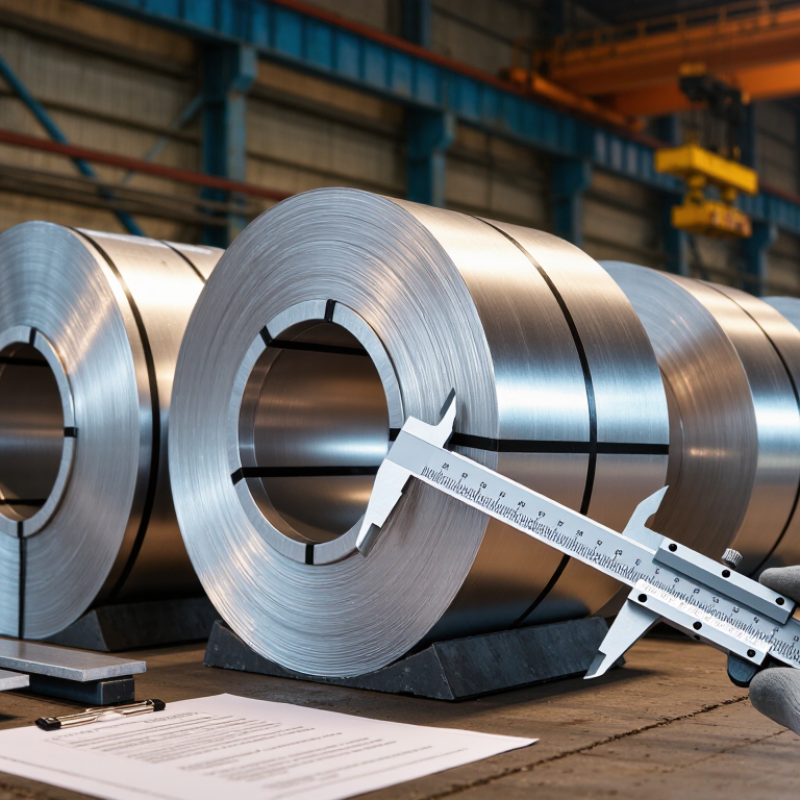
7 Tips for Buying Aluminized Steel Coil: Define the Performance Requirements
Performance requirements should come before price, thickness, or delivery terms. Identify the service temperature, corrosion exposure, forming method, and expected operating life. ASTM A463/A463M covers aluminum-coated carbon steel sheet and defines coating classes, including approximate total coating masses from 75 to 183 g/m² for T1 through T3 grades. More coating is not automatically better. It may affect forming, welding, and cost.
Specify the substrate strength and thickness tolerance clearly. For exhaust ducts, heat shields, or industrial panels, continuous exposure temperature matters. For outdoor storage tanks, use ISO 9223 atmospheric corrosivity categories, ranging from C1 to CX, to describe the environment. Salt spray, condensation, sulfur compounds, and trapped moisture can change the selection. Ask for coating mass test results, tensile data, bend-test performance, and heat-resistance evidence. Request the actual mill certificate.
Watch the details.
In practical purchasing reviews, many failures begin with vague terms like “high corrosion resistance.” That phrase cannot replace a defined coating class or test condition. Confirm whether the quoted coating mass applies to both surfaces and which test method was used. A neat specification can still be wrong. I would also include a small forming trial before approving a large order, because laboratory data may not reflect sharp bends, damaged edges, or production handling. Sources: ASTM A463/A463M and ISO 9223.
Buying aluminized steel coil requires more than comparing a bright surface. Tip 1: Identify the coating type. ASTM A463/A463M distinguishes Type 1, an aluminum-silicon coating, from Type 2, commercially pure aluminum. Type 1 often suits heat exposure and forming. Type 2 generally prioritizes atmospheric corrosion resistance. They are not interchangeable. Tip 2: Confirm coating mass, not appearance. A shiny coil can still have insufficient protection. Ask for coating test results and sampling details.
Tip 3: Match the steel grade to the forming process. Check yield strength, tensile strength, elongation, and carbon content. Tip 4: Specify thickness and width tolerances clearly. Include coil inside diameter, outside diameter, maximum weight, and edge condition. These details affect press setup and transport. Tip 5: Review surface and temper requirements. Smooth, regular surfaces support painting and controlled forming. Minor defects may still matter during deep drawing. Tip 6: Request mill test certificates and traceability records. World Steel Association’s World Steel in Figures 2024 reports approximately 1,892.5 million tonnes of crude steel production in 2023. That huge output does not guarantee consistent coil quality.
Tip 7: Compare total performance, not only price. Consider heat cycles, corrosion exposure, bending radius, welding needs, and expected service life. ASTM requirements provide a baseline, but application testing remains valuable. A recurring mistake is choosing a heavier coating while ignoring the steel grade. I would test a small coil first. Real forming results can challenge a perfect datasheet. Loose specifications create expensive surprises.
7 Tips for Buying Aluminized Steel Coil
Check Surface Quality, Dimensions, and Manufacturing Consistency
Buying aluminized steel coil requires more than comparing prices. Inspect the surface under bright, even light. Look for scratches, bare spots, wrinkles, stains, and uneven coating. Small marks can become serious after stamping or forming. I once accepted a visually attractive coil without checking the edges. That mistake caused feeding problems later. Check both coil sides, not only the exposed outer layer. Ask for coating weight, steel grade, and surface-finish details. Request a sample when the application is demanding.
Measure thickness and width at several points across the coil. Do not rely only on the supplier’s stated dimensions. Confirm inner diameter, outer diameter, coil weight, flatness, and edge condition. Compare measurements with your forming equipment’s tolerance range. A narrow variation may appear harmless, but it can affect welding, bending, or slitting accuracy. Check the inspection certificate carefully. The figures should match the actual batch.
Consistency deserves equal attention. Review recent production records, mechanical test results, and coating measurements from multiple coils. One good sample proves little. Ask whether the same substrate, heat treatment, and coating process will continue. Uneven color is not always a failure, but unexplained changes need investigation. Verify packaging, labeling, and moisture protection before shipment. Keep photos and measurement records for traceability. Do not ignore small doubts. They often become expensive defects.
Reference acceptance targets commonly used in purchase specifications and receiving inspection plans. Confirm the final limits against the applicable ASTM or EN standard, coating designation, and agreed mill specification.
A reliable aluminized steel coil should be free from visible rust, cracks, blisters, laminations, and unacceptable surface defects. Dimensional checks normally focus on thickness, width, flatness, and coating-mass consistency, while manufacturing consistency is verified through repeatable mechanical-property and traceability records.
In practice, a reliable supplier should provide clear mill details, production capacity, and recent inspection records. Ask for the steel grade, coating type, coating mass, thickness tolerance, and coil weight. Certificates should match the agreed standard, such as ASTM or EN requirements. A certificate alone is not enough. Check whether the document identifies the actual heat number and inspection date. I once overlooked this detail, and tracing a coil later became unnecessarily difficult.
Request itemized quotations instead of accepting one total figure. Compare base steel cost, coating charges, slitting fees, packaging, insurance, and transportation. Confirm the minimum order quantity and quotation validity period. A low price may hide weaker packaging or longer production times. Calculate the delivered cost per ton. That number matters more than the headline price.
Confirm the production lead time, loading port, shipping method, and agreed Incoterm. Ask how coils will be wrapped against moisture, edge damage, and shifting during transport. The contract should state acceptable width, thickness, surface, and quantity tolerances. Include a practical claims process with inspection deadlines and photo requirements. Delivery promises can sound precise but remain vague without milestones. Keep communication written. Small misunderstandings often become expensive.
7 Tips for Buying Aluminized Steel Coil
Buying aluminized steel coil starts with the service environment, not the lowest quotation. Confirm the steel grade, thickness, width, coating type, and coating mass. Check whether the coil suits bending, stamping, welding, or high-temperature exposure. A material that forms well may still fail after repeated heating. Ask for test certificates, dimensional tolerances, and coating inspection records. Verify packaging quality before shipment. Small dents can become corrosion points later.
Storage conditions deserve equal attention. Keep coils indoors, raised above the floor, and away from leaking roofs or chemical vapors. Allow air to circulate around each coil. Condensation is a quiet problem. Avoid storing cold coils in warm, humid areas without acclimatization. Inspect the edges and wrapping weekly during long storage. I have seen good material develop stains because the packaging looked intact, but moisture was trapped inside. That mistake is easy to repeat.
Think beyond installation. Estimate operating temperature, humidity, salt exposure, cleaning chemicals, and expected service years. Confirm whether the coating supports the forming process and planned maintenance schedule. Ask how scratches, cut edges, and weld areas will be protected. Keep batch numbers and inspection results for future traceability. Do not rely on a generic “corrosion resistant” statement. It may be technically true, yet unsuitable for your location. When requirements are uncertain, request a sample trial or independent coating review before committing to a large order. A cheaper coil can become expensive through replacement, downtime, and repeated inspections.
| Tip | Buying Decision | What to Confirm | Practical Selection Guidance | Risk if Overlooked | Recommended Purchasing Action |
|---|---|---|---|---|---|
| 1 | Match the Steel Grade to the Application | Confirm the base steel grade, yield strength, tensile strength, elongation, and forming requirements. | Commercial-quality material is commonly used for general fabrication. Drawing-quality or structural grades may be more suitable for deep forming or load-bearing components. Verify the required mechanical properties against the applicable specification, such as ASTM A463/A463M where relevant. | Cracking during forming, insufficient load capacity, springback, or premature component failure. | Provide the supplier with the finished-part geometry, forming method, minimum bend radius, and required mechanical-property range before requesting a quotation. |
| 2 | Select the Correct Aluminized Coating Type | Determine whether the application requires Type 1 or Type 2 aluminized steel and confirm coating mass or thickness. | Type 1 generally uses an aluminum-silicon coating and is widely used for heat resistance and general corrosion protection. Type 2 generally uses a commercially pure aluminum coating and is often selected when atmospheric corrosion resistance is the primary need. The actual coating designation and mass should be stated on the quotation and test documents. | Reduced corrosion resistance, unsuitable heat performance, coating damage during fabrication, or higher lifecycle cost. | Specify the coating type, coating mass, test method, and acceptable tolerance instead of ordering only by the phrase “aluminized steel.” |
| 3 | Check Temperature and Chemical Compatibility | Review continuous operating temperature, short-term peak temperature, atmosphere, moisture, salts, sulfur compounds, acids, and alkalis. | Aluminized steel is commonly considered for heat-related equipment, exhaust components, ducting, and industrial enclosures. Performance depends strongly on temperature cycling and the surrounding chemicals; concentrated acids, strong alkalis, and certain high-sulfur environments can attack the coating. | Accelerated coating degradation, scaling, perforation, distortion, or loss of service life. | Supply a written service profile covering temperature range, exposure duration, condensate conditions, and chemical contaminants. Request application-specific compatibility confirmation when conditions are severe. |
| 4 | Verify Dimensions and Processing Tolerances | Confirm thickness, width, coil inside diameter, outside diameter, maximum coil weight, edge condition, flatness, and dimensional tolerances. | Thickness and width must match the slitting, stamping, roll-forming, or laser-cutting equipment. Coil dimensions should also be compatible with the pay-off reel, lifting equipment, and storage capacity. Tolerances should be agreed in writing because they vary by product specification and processing route. | Production stoppages, feeding problems, excessive scrap, equipment damage, or inability to load the coil safely. | Share the line’s allowable thickness and width range, mandrel dimensions, maximum coil weight, and required edge quality before placing the order. |
| 5 | Plan Proper Storage and Handling | Confirm warehouse humidity control, protection from condensation, floor loading, coil orientation, packaging, and lifting method. | Store coils indoors in a clean, dry, well-ventilated area. Keep them away from direct water, leaking roofs, wet floors, and corrosive chemicals. Use dunnage to prevent contact with the floor and avoid abrupt temperature changes that can create condensation. Follow the supplier’s packaging and handling instructions. | Wet storage stain, white corrosion products, edge damage, telescoping, denting, and reduced coating appearance. | Define the storage location and handling equipment before delivery. Inspect packaging and coil surfaces upon arrival, and record any moisture or mechanical damage immediately. |
| 6 | Evaluate Fabrication and Joining Methods | Review bending, punching, cutting, welding, fastening, painting, and edge-treatment requirements. | Forming should be selected to limit coating cracking and galling. Welding or thermal cutting can remove or damage the coating near the joint, so affected areas may require cleaning and a compatible repair coating. Confirm paint adhesion and surface-preparation requirements if the material will be painted. | Cracked coating, poor weld quality, fumes, loss of local corrosion protection, or premature rust at cut edges and joints. | Conduct a small process trial using the intended tooling and joining parameters. Include requirements for ventilation, edge protection, weld-zone treatment, and post-fabrication inspection. |
| 7 | Assess Long-Term Service and Documentation Needs | Confirm expected service life, inspection intervals, warranty requirements, traceability, certificates, and acceptance criteria. | Long-term performance depends on coating type, coating mass, base steel, fabrication damage, temperature, moisture, and pollutants. A complete material certificate should identify the grade, dimensions, coating designation, heat or coil number, mechanical properties, and applicable test results. | Difficult root-cause analysis, inconsistent replacement material, unplanned maintenance, and higher total ownership cost. | Define incoming inspection, coating and dimensional checks, certificate requirements, sample retention, storage limits, and service inspection procedures in the purchase specification. |
By continuing to use the site, you agree to the use of cookies. more information
The cookie settings on this website are set to "allow cookies" to give you the best browsing experience possible. If you continue to use this website without changing your cookie settings or you click "Accept" below then you are consenting to this.