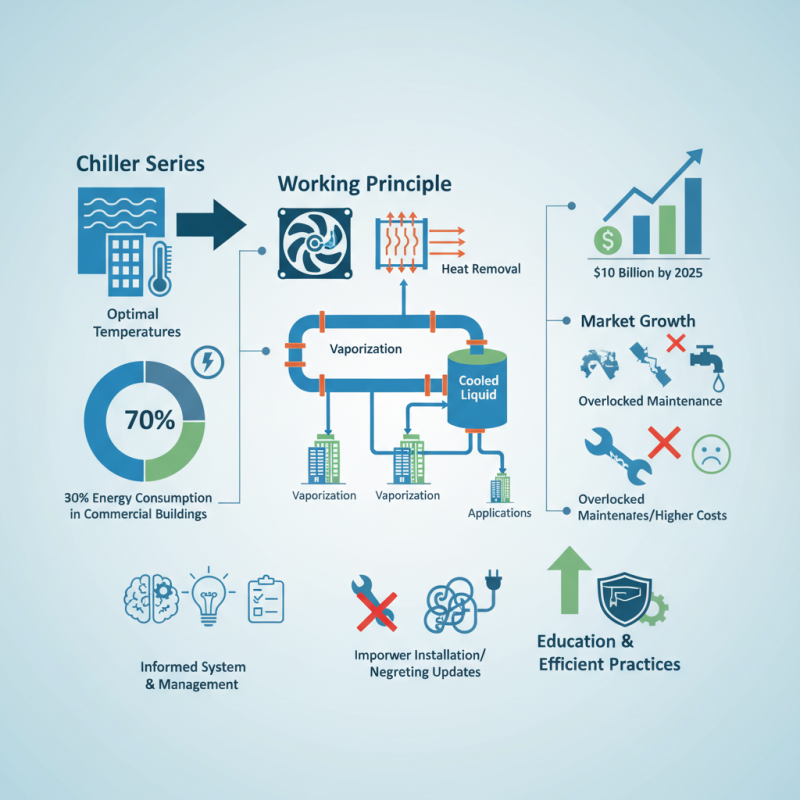
In modern HVAC systems, the "Chiller Series" plays a crucial role in maintaining optimal temperatures. A recent industry report highlights that chillers account for around 30% of the total energy consumption in commercial buildings. This underscores their significance in energy efficiency and sustainability initiatives.
Challer systems work by removing heat from liquids through vaporization, providing cooling for various applications. The market for chillers is projected to reach over $10 billion by 2025, reflecting their growing importance in industrial and commercial sectors. However, many users overlook maintenance needs, which can lead to inefficiencies and higher operational costs.
Understanding the Chiller Series is essential for informed system selection and management. While they provide efficient cooling solutions, improper installation or neglecting updates can create long-term challenges. A call to action remains for industries to prioritize education and efficient practices surrounding chiller systems.
A chiller series is a collection of interconnected refrigeration units designed to manage temperature in large spaces. These systems are crucial for maintaining a comfortable environment in industrial settings, commercial buildings, and even some residential areas. They primarily function by removing heat from liquids, typically water, and circulating the cooled liquid to various areas that require refrigeration.
The operation of a chiller series involves several components, including compressors, condensers, and evaporators. Compressors are responsible for compressing refrigerant gas, leading to increased pressure and temperature. Next, the gas moves to the condenser, where it releases heat and converts back to a liquid state. This liquid then flows to the evaporator, absorbing heat from the environment. As this process continues, an efficient cycle is created, but it often needs regular maintenance. Some systems struggle with leaks, leading to waste and inefficiency.
Besides technical issues, the choice of chiller series can be daunting. Factors like energy consumption and capacity must be considered carefully. Overlooking these can result in systems that do not meet requirements. Each building has unique needs, and ignoring this can lead to underperformance. Even with the best technology, an unsuitable chiller can spell trouble, emphasizing the need for thoughtful planning.
What is a Chiller Series?
Model
Cooling Capacity (kW)
Energy Efficiency Ratio (EER)
Refrigerant Type
Noise Level (dB)
Chiller A
150
3.5
R410A
65
Chiller B
200
3.8
R134A
70
Chiller C
250
4.0
R404A
68
Chiller D
300
4.2
R1234ze
72
Key Components of a Chiller Series
A chiller series is an important system in temperature control. It efficiently cools fluids used in various industrial processes. The key components of a chiller series include compressors, evaporators, condensers, and expansion valves. Each component has a unique role, and the synergy between them ensures optimal performance.
Compressors circulate refrigerant through the system. They feel powerful yet can be complex and noisy. Evaporators absorb heat from the fluid, cooling it down. These can sometimes be less efficient, causing concerns in energy usage. Condensers release the absorbed heat. Poor maintenance can lead to inefficiencies, increasing operational costs. Lastly, expansion valves control refrigerant flow. Failure in these valves can disrupt the entire chilling process.
Understanding each part helps optimize the system. This requires constant monitoring and adjustments. Some chillers underperform due to outdated components. Regular maintenance often reveals hidden issues. A noticeable drop in performance might prompt a reevaluation of the entire series. Each component needs attention, and neglecting even one can compromise the system’s effectiveness.
How Chiller Series Operate: The Cooling Process
Chiller series play a significant role in commercial cooling. They operate by removing heat from a designated area, ensuring an optimal environment for various applications. The cooling process involves a refrigerant that circulates through the system, absorbing heat as it transitions from a liquid to a gas. This absorption happens inside the evaporator, where the refrigerant takes in unwanted heat.
Once the refrigerant turns to gas, it moves to the compressor. Here, the gas gets compressed, raising its temperature and pressure. After this, it travels to the condenser, which releases the absorbed heat outside. The refrigerant then cools down and condenses back into a liquid, ready to repeat the cycle. It's interesting to note that the effectiveness of this process can vary, depending on several factors like ambient temperature or system load.
Sometimes, systems misperform due to improper maintenance or inefficient design. Regular checks are crucial to avoid noticeable drops in efficiency. Although modern chillers are designed for high performance, they can still face challenges with wear and aging components. Rethinking maintenance strategies could lead to improved operation and extended lifespan of the system.
Types of Chiller Series and Their Applications
Chillers are crucial in many industries. They provide a cooling solution for various applications. The most common types of chiller series include air-cooled, water-cooled, and absorption chillers. Each type has its unique uses and benefits.
Air-cooled chillers are widely used in commercial buildings. They function by using ambient air for cooling. According to industry data, about 60% of commercial facilities utilize air-cooled chillers. They are ideal for smaller systems where space is a concern. However, they may have lower efficiency in high ambient temperatures.
Water-cooled chillerWater-cooled chillers are often found in large industrial settings. They use a cooling tower to disperse heat. This type is known for its high efficiency. Research indicates they can reduce energy costs by up to 20% compared to air-cooled units. Yet, installation requires more space and a higher upfront cost. Absorption chillers are less common but valuable in specific scenarios. They utilize heat instead of electricity, making them suitable for locations with surplus waste heat. However, their efficiency can be lower, leading to more complex operational challenges. Each chiller type has its strengths and weaknesses.
Benefits of Using Chiller Series in Various Industries
Chiller series play a crucial role in various industries, offering significant benefits. In manufacturing, they cool machinery to prevent overheating. This ensures smooth operation and increases equipment lifespan. Factories often face challenges with heat waste. A chiller series can effectively manage this issue by providing precise temperature control.
In the food and beverage industry, maintaining optimal temperatures is vital. Chill systems preserve freshness and prevent spoilage. Yet, many companies struggle with energy efficiency. A well-designed chiller series can reduce energy consumption while ensuring ideal conditions for products. This balance is key for profitability and sustainability.
Moreover, in data centers, temperature regulation is essential. Servers generate considerable heat. Without proper cooling, performance degrades, and equipment risks damage. Yet, many data centers fail to optimize their cooling systems. By adopting chiller series, companies can enhance reliability and performance. The technology offers a chance to innovate, but not all organizations realize their potential.
By continuing to use the site, you agree to the use of cookies. more information
The cookie settings on this website are set to "allow cookies" to give you the best browsing experience possible. If you continue to use this website without changing your cookie settings or you click "Accept" below then you are consenting to this.