
Blog
How to Choose the Best Slim Smart Lock?
Choosing the right Slim Smart Lock requires more than comparing thickness, price, and glossy photographs. A narrow body may fit a crowded door, yet poor battery access can create daily frustration.
MarketsandMarkets estimates that the global smart lock market will grow from approximately USD 2.2 billion in 2023 to USD 4.4 billion by 2028. That growth reflects rising demand for keyless entry, remote control, and connected home security. However, market growth does not guarantee product quality. Reports often combine residential, commercial, and hospitality devices. Their numbers can hide important differences.
Fit matters.
Measure your door thickness, backset, handle clearance, and interior space before choosing a lock. Check whether the Slim Smart Lock supports your existing cylinder or requires replacement hardware. Battery life, low-power warnings, emergency access, and offline operation deserve equal attention. A beautiful lock becomes inconvenient when its battery compartment sits behind a fixed panel.
Cybersecurity also requires careful inspection. Look for encrypted communication, two-factor authentication, firmware updates, and clear data policies. Bruce Schneier, a respected security technologist, offers a useful warning: “Security is a process, not a product.” His point applies directly to connected locks. Security depends on updates, user habits, and manufacturer support after installation.
The best choice is rarely the thinnest model. It is the lock that balances physical compatibility, dependable access, privacy, and long-term maintenance. Some comparisons overlook installation skill and household routines. That is a weakness worth acknowledging. A practical decision begins with your door, your users, and the moments when technology may fail.
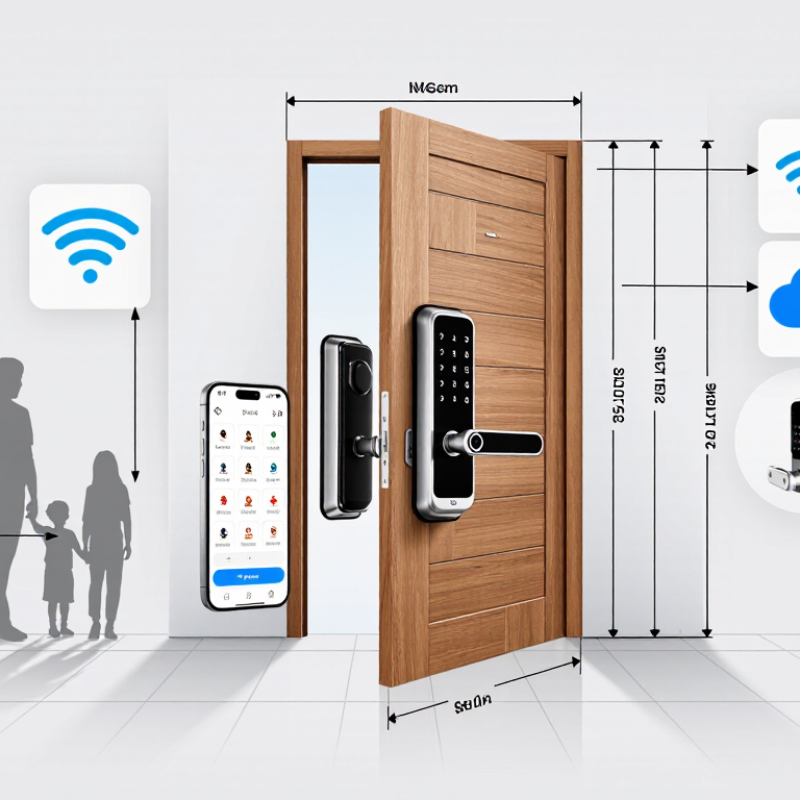
Table of Contents [Hide]
Define What a Slim Smart Lock Is and How It Works
A slim smart lock is a compact electronic lock designed for doors with limited space. Unlike bulky models, it keeps the interior unit narrow and close to the door surface. It usually replaces the existing thumb-turn while keeping the original cylinder. This can reduce drilling and preserve the door’s appearance. Some models also include a keypad or fingerprint reader. That detail matters.
Inside, a small motor turns the lock mechanism after receiving an authorized command. The command may come through Bluetooth, Wi-Fi, a keypad, or a mobile application. Bluetooth works well when standing near the door. Wi-Fi can support remote control, but it may require an additional hub. Power usually comes from standard batteries hidden beneath the interior cover. Low battery alerts are essential.
Choosing the right slim smart lock starts with accurate measurements. Measure the door thickness, cylinder length, backset, and interior clearance. Check whether the motor can turn the existing thumb-turn smoothly. During a retrofit assessment, I have seen a lock fail because the thumb-turn was stiff, not because the electronics were weak. Measure twice. A reliable design should offer encrypted communication, temporary access codes, activity logs, and clear permission controls. Its mechanical override should remain usable during a power or network problem. Connectivity can fail. A strong lock respects that reality, although installation instructions are sometimes less clear than they should be.
How to Choose the Best Slim Smart Lock? - Define What a Slim Smart Lock Is and How It Works
| Evaluation Dimension | Typical Data or Specification | What It Means | Selection Guidance |
|---|---|---|---|
| Definition of a Slim Smart Lock | A compact electronic lock designed to reduce the interior or exterior footprint while adding digital access control | “Slim” usually describes a narrow lock body, compact interior module, or low-profile exterior hardware. It is not one universally fixed size category. | Check the complete dimensions, including the thumb-turn, battery housing, keypad, and escutcheon rather than relying only on the word “slim.” |
| Basic Operating Principle | A motor or electronic clutch moves the existing latch or deadbolt after an authorized command | The lock combines an electromechanical actuator, control circuit, access credential, and power source. Manual operation may remain available, depending on the design. | Prefer a design that keeps a reliable mechanical override and does not prevent emergency exit from inside. |
| Common Access Methods | Mobile app, Bluetooth, keypad code, fingerprint, NFC credential, physical key, or voice assistant through a compatible hub | Different access methods suit different users. Bluetooth often works locally, while remote access normally requires a gateway or internet-connected controller. | Choose at least two independent entry methods, such as a keypad plus mechanical key or smartphone plus PIN. |
| Communication Protocols | Bluetooth Low Energy; some models also support Wi-Fi, Thread, Z-Wave, or Matter through integrated radios or a bridge | Bluetooth is generally designed for nearby control and lower power use. Wi-Fi enables direct remote connectivity but normally consumes more energy. | Confirm whether remote control needs a separate hub and whether the lock works with the smart-home platform you use. |
| Lock Body Profile | Compact interior module commonly measures approximately 30–55 mm in depth; actual dimensions vary by mechanism | A smaller interior profile leaves more space around the door handle, frame, or adjacent furniture. | Measure the available clearance from the door edge, handle, wall, glass panel, and nearby cabinets before purchasing. |
| Door Compatibility | Compatibility depends on door thickness, backset, lock case, cylinder type, handing, and whether the door uses a deadbolt or multipoint system | A smart lock can be electronically advanced but still unsuitable if its mechanical dimensions do not match the door. | Record door thickness, backset, center distance, cylinder dimensions, and lock-case type before installation. |
| Typical Door Thickness | Many residential products support approximately 35–55 mm, but the supported range is model-specific | The lock’s mounting screws, spindle, cylinder, and interior housing must fit the door thickness securely. | Do not modify the door unless the installation instructions specifically allow it; verify the supported range in advance. |
| Power Source | Replaceable alkaline or lithium batteries are common; rechargeable battery packs and wired power options are also available | Battery-powered locks can be installed without new wiring, while wired systems may be better suited to continuous-use entrances. | Select a product with accessible battery replacement and a clearly stated low-battery warning. |
| Battery Life | Often several months to about one year under normal residential use; keypad, Wi-Fi, temperature, and traffic can reduce runtime | Advertised endurance is usually based on a defined usage pattern and may not reflect heavy use or weak wireless signals. | Compare test conditions, expected daily cycles, battery type, and whether remote connectivity is always active. |
| Emergency Power | Some battery-operated models provide external contacts for temporary power from a standard 5 V USB power bank | External power can restore electronic operation when internal batteries are depleted, but it does not replace a mechanical backup. | Check the emergency power connector location and keep the required cable or power source available when appropriate. |
| Security Encryption | Secure Bluetooth and smart-home protocols generally use authenticated, encrypted communication; implementation varies by product | Encryption helps protect commands and credentials during wireless communication, but account security and firmware quality also matter. | Look for encrypted communication, signed firmware updates, secure account recovery, and two-factor authentication where available. |
| User and Guest Management | Temporary PINs, scheduled permissions, revocable digital keys, activity records, and administrator controls are common features | Digital credentials can be issued and cancelled without changing the physical key cylinder. | Choose a system that supports expiration dates, individual users, event logs, and immediate credential revocation. |
| Indoor and Outdoor Protection | Outdoor components may have an IP rating or weather-resistance specification; indoor modules are often less exposed | An IP rating describes protection against solid particles and water under defined test conditions. It does not guarantee resistance to every climate. | For exposed doors, verify the stated operating temperature, rain and dust protection, and keypad durability. |
| Mechanical Override | Physical key, interior thumb-turn, or manual lever operation, depending on the lock architecture | A mechanical path can provide access during battery, network, app, or electronic-control failure. | Confirm that the override works independently and that occupants can always unlock the door from the inside. |
| Installation Complexity | Retrofitting an existing compatible cylinder or deadbolt is usually simpler than replacing a mortise or multipoint lock case | Installation time depends more on the door’s existing hardware and alignment than on the lock’s smart functions. | Prioritize a model with clear templates, adjustable components, alignment tolerance, and documented compatibility. |
| Door Alignment Requirement | The latch or bolt should extend and retract smoothly without excessive force or rubbing | A motor has limited torque. A misaligned door can cause noise, stalled movement, rapid battery drain, or premature wear. | Correct hinges, strike plates, and weather seals before installing the smart mechanism. |
| Best Use Cases | Apartments, offices, rental properties, guest rooms, interior doors, and entrances where a low-profile appearance is important | Slim designs are especially useful where space, appearance, or minimal changes to existing hardware are priorities. | Match the lock architecture to the door’s security requirements instead of choosing based on appearance alone. |
| Key Selection Criteria | Mechanical fit, emergency access, credential options, battery management, security updates, weather resistance, and privacy controls | A balanced decision considers physical security and everyday usability together with smart connectivity. | Use a measurement checklist and test the manual operation, app permissions, and failure procedures before final installation. |
Note: Dimensions, battery life, wireless features, environmental ratings, and supported door configurations vary by product design. Always confirm the installation guide and technical specification for the exact model.