
Choosing Custom Clear Umbrellas for your business involves more than adding a logo to a transparent canopy. The right design should suit how customers will use it, where it will be carried, and what your brand needs to communicate. A clear canopy can keep a person’s view open on a rainy street, while a colored trim or compact handle makes the umbrella easier to recognize. Small details matter.
Start by comparing canopy material, frame construction, opening mechanism, and handle comfort. Ask suppliers for product specifications, available sizes, printing methods, and care instructions. If possible, review a physical sample before approving a large order. Check how the logo looks against the canopy in daylight and under indoor lighting. Request details about durability testing rather than relying on broad claims. A product image alone cannot show how a frame feels in the hand.
Then consider practical use. A lightweight model may suit event giveaways, while a sturdier frame could be more appropriate for frequent daily use. Neither choice is automatically better. Rain, wind, storage space, and budget all affect the decision. Branding can also be overdone; a large graphic may compete with the clear design instead of supporting it. That is easy to miss on a screen. This guide outlines the key choices, questions to ask suppliers, and trade-offs to weigh before placing an order. A careful comparison helps businesses select umbrellas that look on-brand and feel dependable in real use.
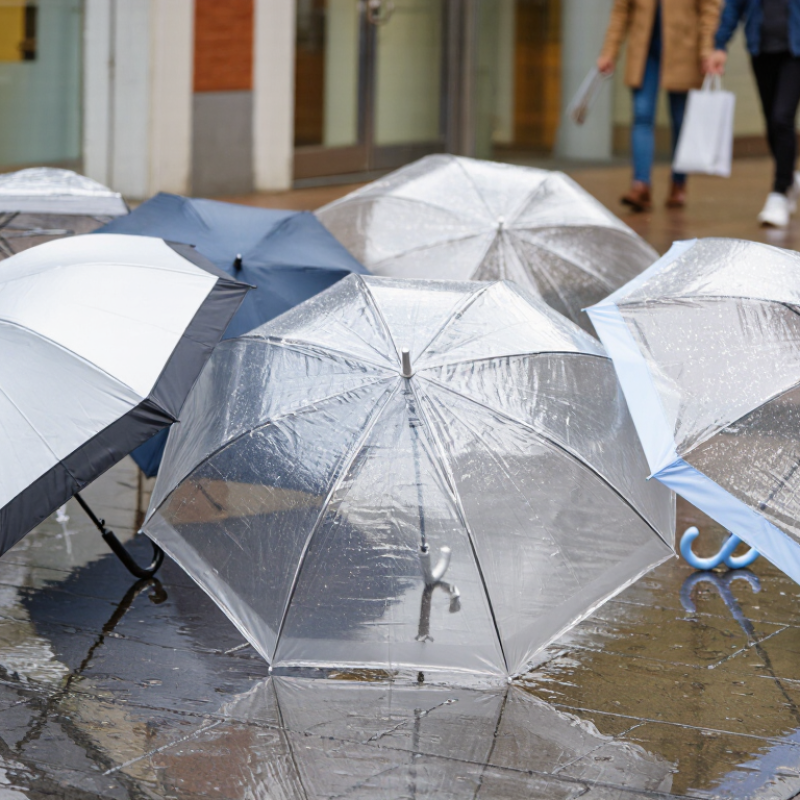
Before ordering custom clear umbrellas, define where they will be used and who will carry them. A hotel may need transparent canopies for guest transfers, while an event team may prioritize visibility in crowded queues. The Fifth National Climate Assessment (2023) reports that average annual precipitation across the contiguous United States has risen about 4% since 1901, with substantial regional differences. That national figure is only a starting point. Check NOAA’s 1991–2020 U.S. Climate Normals for monthly precipitation near your operating location, then match order quantities and timing to local conditions.
Get specific about buyer requirements. Will people use the umbrellas for a five-minute walk between buildings or a full commute? Ask about canopy diameter, handle comfort, frame strength, folded length, and storage space. Clear material helps users see through the canopy, but printed artwork can reduce visibility if it covers too much of the panel. Request a sample and test it outdoors; a product that looks good under showroom lights may feel awkward in wind. Small detail. Also confirm artwork dimensions, delivery deadlines, packaging, and replacement needs before approving production. I’d avoid treating one successful event as proof of year-round demand; our estimates can be wrong, especially when weather shifts.
Choose canopy size around the person carrying the umbrella, not just the printed diameter. A compact canopy suits commuting and branded handouts, while a wider one gives better shoulder coverage in steady rain. Ask whether the quoted measurement follows the curved edge or spans straight across; suppliers may describe these differently. Check a sample over a real jacket or work uniform. Small differences show quickly.
Frame material affects weight, feel, and durability. Fiberglass ribs flex during gusts and resist rust, while steel can feel firm but adds weight. Aluminum is light, though its strength depends on the frame design. Inspect the joints and runner, too. They often reveal more than the material name alone. A sturdy frame still needs careful handling.
Clear film choices can change visibility and how the canopy ages. Ask for the film type and thickness, then compare samples for haze, flexibility, and yellowing after exposure to sunlight. POE and PVC are common options, but quality varies by formulation and thickness. Feel the film in cooler conditions if the umbrellas will be used outdoors year-round. I would not judge clarity from a product photo; lighting can make an average film look excellent. Check printed logos on the actual film, since ink coverage may affect visibility from inside.
| Typical Canopy Arc | Frame Material | Clear Film Type | Practical Benefits and Trade-Offs | Suitable Business Use | What to Confirm Before Ordering |
|---|---|---|---|---|---|
| 30–32 in (76–81 cm) Compact | Aluminum shaft with steel or fiberglass ribs | PVC | A compact canopy is easy to carry and store. PVC is widely used for transparent umbrella panels, but its flexibility can vary with temperature and film formulation. | Event giveaways, visitor kits, and retail promotions where portability is important. | Ask whether the arc measurement follows the curved canopy and confirm the closed length and handle style. |
| 33–35 in (84–89 cm) Medium | Fiberglass ribs with a steel or aluminum shaft | PVC or POE | Fiberglass ribs are flexible and do not rust. PVC is a common clear-film option; POE is another option whose clarity and flexibility depend on the specific grade. | Staff umbrellas, hotel or restaurant guest use, and general promotional programs. | Request the exact film specification, finished canopy measurements, and a physical sample to assess clarity and feel. |
| 36–38 in (91–97 cm) Roomier | Fiberglass ribs with an aluminum shaft | POE or PVC | A larger canopy can provide more coverage but may be bulkier to carry. Aluminum is lightweight and corrosion-resistant; compare shaft strength and construction for the intended use. | Outdoor venues and businesses providing umbrellas for customers or employees. | Check the open canopy dimensions, rib count, shaft construction, and whether the handle and strap can be customized. |
| 39–42 in (99–107 cm) Large | Steel shaft with fiberglass ribs | PVC or POE | A large canopy offers more coverage but is less compact. Steel can provide a sturdy shaft; a protective finish helps limit corrosion if the coating is damaged. | Guest-service programs where broader coverage is preferred over a small folded size. | Confirm the total weight, folded length, frame finish, and care instructions for the selected film and frame. |
| Size selected for a specific audience or uniform | Choose by weight, flexibility, and storage needs | Choose by sample appearance, flexibility, and supplier specification | Frame and film performance depend on the exact materials and construction—not just the material name. Clear panels may also show seams and condensation. | Branded merchandise, coordinated staff equipment, and customized event orders. | Approve a production sample and confirm artwork placement, print method, minimum order quantity, lead time, and applicable product testing. |
Measurement note: Canopy arc is measured along the curved canopy edge and is not the same as the straight-line width across the open umbrella. Sizes and material properties vary by supplier, so verify the specification and sample before placing a bulk order.
How to Choose Custom Clear Umbrellas for Your Business
ASI’s 2023 finding says 85% of people remember advertisers who use promotional products. That makes a clear umbrella more than a rainy-day giveaway: it can keep your business visible while someone walks along a crowded sidewalk. Its transparent canopy lets the user see ahead, while a printed logo or message can remain noticeable from several steps away. Visibility matters.
Choose a canopy large enough for practical coverage, but not so wide that it feels awkward on a packed bus or narrow pavement. Check the handle for a comfortable grip and the frame for steady, smooth opening. A simple, high-contrast design usually reads better through rain-speckled plastic than fine print or several competing colors. Ask for a sample before ordering. Small details show.
ASI’s figure is encouraging, but it does not guarantee that every recipient will remember your message. People may leave an umbrella behind, or use it only once. Think about who will receive it and where they are likely to carry it. A durable umbrella with a useful design may earn repeat use; an oversized logo can make it feel less personal. That balance is easy to misjudge. Test the artwork at actual size, and check how it looks under indoor lighting as well as outdoors.
How to Choose Custom Clear Umbrellas for Your Business
Clear canopies need more than a bright showroom inspection. Sunlight can gradually yellow transparent film, reduce clarity, or weaken seams. Ask suppliers to test the actual canopy material, not just a similar resin sample. Small details matter.
ASTM D4329 and ISO 4892-3 describe fluorescent UV exposure methods for plastics. They help buyers compare how materials respond to controlled ultraviolet light, heat, and moisture. Specify the lamp type, exposure cycle, temperature, and test duration in writing. Also agree on what to measure, such as yellowing, haze, cracking, or tensile strength. These standards do not set one universal pass-or-fail limit, and their test conditions are not automatically equivalent. Easy to miss.
For a clear umbrella, request baseline and post-test results for the film, printed areas, and bonded seams where practical. A lab report should identify the method and settings, so another test can be repeated. Accelerated exposure helps screen materials, but it cannot predict an exact outdoor service life. I would still compare tested samples with umbrellas used in real weather; that extra check takes time, but it can reveal weaknesses the test misses.
Specify UV and weathering tests using ASTM D4329 and ISO 4892-3.
These are general UV wavelength bands, not lamp-output specifications or exposure settings. When requesting clear-umbrella material testing, identify the applicable ASTM D4329 or ISO 4892-3 method and agree on the lamp, irradiance, temperature, moisture cycle, and exposure duration. Compare results only when test conditions are documented and comparable.
Compare supplier samples under real conditions. Open each umbrella fully and inspect the canopy seams, frame tension, handle grip, and clear panels for scratches or clouding. Look closely. Test your logo on the actual material, not just a digital mockup. Check print alignment from both sides and see whether colors remain legible against bright daylight. ASI’s 2023 Ad Impressions Study found that 85% of consumers could recall an advertiser from a promotional product they owned. A clean, readable mark matters; oversized artwork can feel less useful than a small, well-placed logo.
Ask suppliers for written production and shipping timelines, including proof approval, manufacturing, and transit. Ask for dates. Compare the same order quantity and delivery terms across quotes. Request a cost breakdown for printing, setup, packaging, freight, and any rush fees. The lowest unit price may not mean the lowest total cost. A sample can look excellent while bulk printing varies, so ask how production quality is checked and whether a pre-shipment inspection is available.
For a fair comparison, keep one approved sample as your reference and record defects before ordering. A few cloudy panels may seem minor until a whole batch arrives. Not always easy to predict. Build in time for revisions, especially when your logo has fine lines or pale colors. A realistic schedule and clear quality criteria are often worth more than a small discount.
By continuing to use the site, you agree to the use of cookies. more information
The cookie settings on this website are set to "allow cookies" to give you the best browsing experience possible. If you continue to use this website without changing your cookie settings or you click "Accept" below then you are consenting to this.