Top Engineered Wood Panel Manufacturers in China
China’s engineered wood sector serves furniture makers, builders, and distributors with a broad range of panel products. Engineered Wood Panels include plywood, particleboard, medium-density fiberboard, and oriented strand board. Manufacturers differ in production scale, surface finishes, core materials, and export experience. A useful supplier comparison looks beyond catalogue photos. It checks panel thickness, density, moisture performance, and emissions documentation. Details matter.
This guide introduces leading Chinese manufacturers and the capabilities buyers may want to examine. Product specifications and quality systems can vary between factories, and even between production lines. Ask for current technical data, independent test reports where relevant, and samples that match the intended application. Confirm dimensions, packaging, order quantities, and lead times in writing. Certification claims should be checked against the issuing organization and the specific product range; a company-wide statement may not cover every panel. A polished catalogue can still leave practical questions unanswered. That is worth remembering.
The companies discussed here are starting points, not a substitute for direct evaluation. Compare their product focus, manufacturing transparency, and ability to provide consistent batches. When possible, assess sample edges, surface uniformity, and machining behavior under realistic conditions. No single ranking fits every project. A cabinetmaker may prioritize smooth sanding and stable dimensions, while a construction buyer may focus on structural performance and reliable supply. This overview aims to make those trade-offs clearer without treating marketing claims as proof.
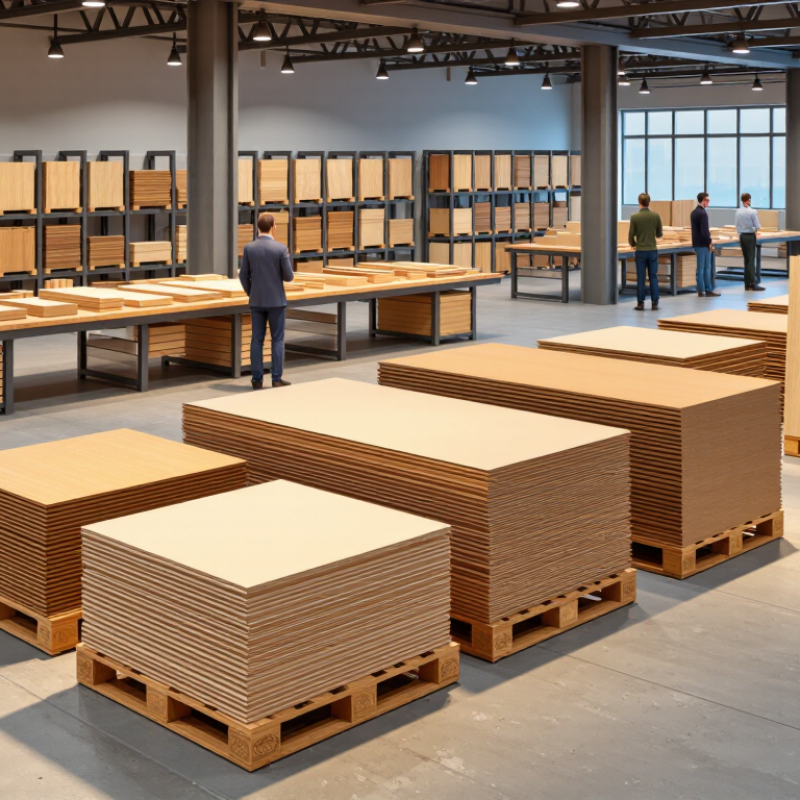
What Engineered Wood Panels Are and How They Are Made
Engineered wood panels are made by bonding wood veneers, strands, fibers, or particles into flat sheets. They use smaller wood pieces efficiently, but their structure differs from solid lumber. Plywood layers thin veneers with alternating grain directions. Oriented strand board (OSB) arranges long strands in crosswise layers. Particleboard uses coarser wood particles, while medium-density fiberboard (MDF) is formed from refined fibers. Small differences matter. They affect stiffness, surface smoothness, and how well an edge holds a screw.
Production usually starts with debarking and chipping, followed by drying and adhesive application. Machines form the material into a loose mat, then hot presses apply heat and pressure. Panels are trimmed, sanded, and graded. The line is precise, but not perfectly uniform: moisture and particle size can change the finished sheet. The FAO’s 2023 Global Forest Products Facts and Figures reports about 401 million cubic metres of wood-based panels produced worldwide in 2022. That scale makes consistent raw-material control important. For buyers comparing Chinese-made panels, ask for product specifications and test reports covering thickness, bonding, and formaldehyde emissions; appearance alone tells little.
Main Types of Engineered Wood Panels Produced in China
China’s engineered-panel sector covers several products, not one interchangeable material. FAOSTAT’s 2022 Forestry Production and Trade data lists China as the leading producer of Wood-Based Panels. Plywood is a major category: thin veneers are layered with alternating grain directions, then pressed into stiff sheets. It is widely used in furniture, interiors, concrete formwork, and structural applications. Edge quality matters. Poor bonding can show up as peeling after moisture exposure.
Particleboard uses small wood particles bonded with resin, creating economical, uniform boards for cabinets and furniture cores. Fibreboard, especially medium-density fibreboard, is made from refined wood fibres. Its smooth face suits painted doors and routed panels, though edges need careful sealing. The FAO data tracks fibreboard and particleboard separately, reflecting their distinct product groups and production markets.
Oriented strand board uses aligned strands in layered mats, offering strength for sheathing and flooring. China also manufactures laminated veneer lumber and other structural composites, although availability and specifications vary by mill. Buyers should check thickness tolerance, bonding class, emissions documentation, and intended-use test results. A panel’s name alone is not enough. Grades and performance can differ, and published product claims still need independent verification.
How to Assess Engineered Wood Panel Manufacturers
Top Engineered Wood Panel Manufacturers in China
How to Assess Engineered Wood Panel Manufacturers
Assess manufacturers through documented performance, not catalogue claims. China is a major sourcing base: FAO’s Global Forest Products Facts and Figures 2023 reports that China produced about 54% of the world’s wood-based panels in 2022, when global production reached 399 million cubic metres. Large output does not guarantee consistent quality. Request specifications for each panel grade, including thickness tolerance, density, moisture content, and intended use.
Check recent third-party test reports and confirm the methods match your destination market. For formaldehyde emissions, ask which test method was used, such as ISO 12460-5, and whether the tested product matches the material being quoted. Inspect sample edges for voids and uneven core layers. Numbers are not enough. A surface can look smooth while internal bonding varies, so request batch-level quality records and examine panels from more than one production run.
Verify production capacity against actual equipment, shift schedules, and lead times. A factory visit can reveal storage conditions, calibration practices, and how rejected panels are handled. Ask how wood inputs are tracked and whether the supplier can provide supporting records. Compare sample results with delivered goods, then document acceptable tolerances in the purchase specification. One weakness in this process: a short audit cannot predict every production issue, so retain inspection rights for later shipments.
Assessing Engineered Wood Panel Manufacturers: Formaldehyde Emission Limits
GB/T 39600—2021 defines maximum formaldehyde emission levels of 0.124 mg/m³ for E1, 0.050 mg/m³ for E0, and 0.025 mg/m³ for ENF. These are classification limits, not test results from individual manufacturers. When comparing suppliers, request current test reports for the specific panel product and confirm the testing method and class.
Leading Engineered Wood Panel Manufacturers in China
Leading engineered wood panel manufacturers in China compete on more than output. FAO’s Global Forest Products Facts and Figures 2023 reports that worldwide wood-based panel production reached about 373 million cubic metres in 2022, with China the largest producing country. That scale supports broad sourcing options, but it does not prove that every factory offers consistent quality.
Buyers should compare panel type, thickness tolerance, bonding performance, and moisture control against the intended use. Ask for recent test reports and check whether they identify the exact product and production site. A factory visit can reveal practical details: calibrated presses, clean sanding lines, and panels stored flat and dry. Small clues matter. A polished showroom alone tells little.
For formaldehyde emissions, request results from a recognized test method and verify the applicable grade for the destination market. ISO standards can help buyers compare test procedures, though a standard is not a substitute for current product-specific evidence. The FAO production figures describe an industry, not individual factories. That distinction is easy to overlook. Even a capable supplier may show uneven consistency across thicknesses or batches, so trial orders and incoming inspections remain sensible safeguards.
Market Trends Shaping China's Engineered Wood Panel Industry
China’s engineered wood panel industry is being shaped by tighter buyer expectations, changing construction needs, and pressure to use resources more efficiently. Low-emission adhesives are gaining attention, especially for panels used in homes, schools, and offices. Buyers increasingly ask for clear product documentation, not just a low price. Small details matter: a consistent panel thickness, a clean cut edge, and reliable moisture performance.
Manufacturers are also investing in automation and digital quality checks. Sensors can flag density or thickness variations before panels leave the line. This helps reduce waste, though equipment alone cannot fix uneven raw materials. Recycled wood fibers and fast-growing timber are part of the resource conversation. Yet supply quality can vary, and sorting takes time. Progress is real, but not uniform.
Product development is moving toward panels designed for specific uses, including furniture, interior fit-outs, and structural applications. Builders want dependable performance and easier installation. Meanwhile, energy costs and transport expenses still affect production decisions. Green-building requirements may create opportunities, but buyers need practical evidence, such as emissions test results and traceable specifications. A label is not enough. Manufacturers that balance cost, consistency, and credible environmental claims are better positioned, although no single approach suits every market.