
A Centrifugal Flow Fan can be a strong choice when a system needs steady airflow against meaningful resistance. Ducts, filters, coils, and process equipment all add pressure losses. A centrifugal fan moves air through a rotating impeller, then redirects it outward into the housing. That design can suit installations where airflow must travel through a defined route. The details matter.
The right fan is not chosen by appearance or headline efficiency alone. Engineers compare required airflow and static pressure, then check the fan curve against the actual operating point. Theodore von Kármán, an influential aerospace engineer, observed, “Scientists study the world as it is; engineers create the world that never has been.” His words offer a useful lens for fan selection: calculations need to meet real conditions. A clean test result is not the whole story.
Consider a workshop with a dusty filter and a long duct run. As the filter loads, resistance rises, and airflow may fall. A properly selected fan can help maintain performance, but poor sizing, leakage, or a badly designed inlet can waste energy and add noise. There is no perfect fan. Even good choices involve trade-offs between space, sound, cost, and efficiency. Some assumptions will need checking after installation. This guide explores where centrifugal fans perform well, what specifications deserve attention, and which practical questions to ask before choosing a model.
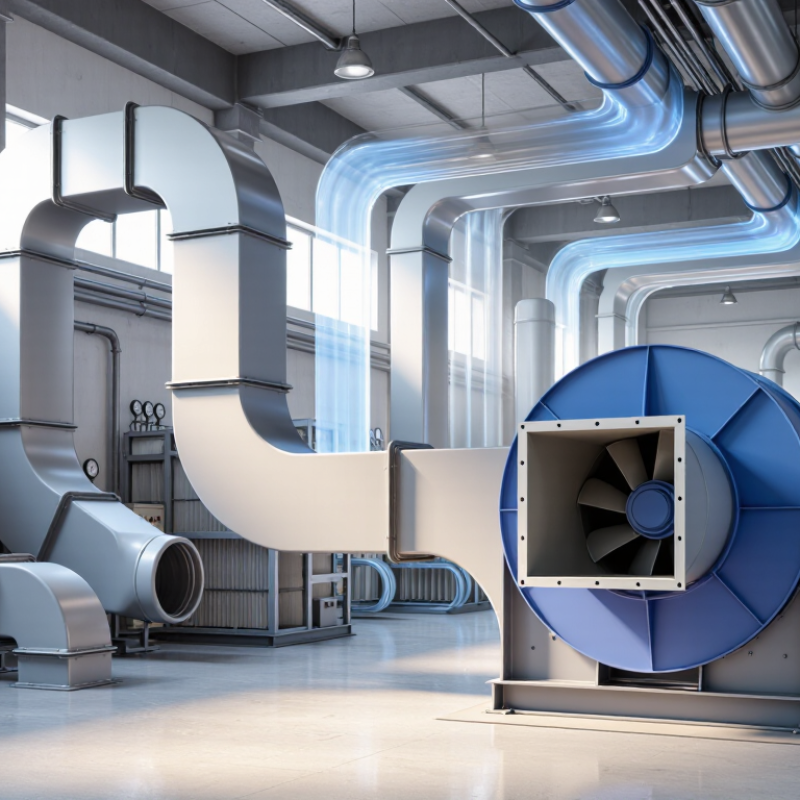
A centrifugal flow fan moves air by changing its direction. Air enters near the center of a rotating impeller, where the blades push it outward. Inside the scroll-shaped casing, some of the air’s velocity becomes pressure. The outlet then guides the air into a duct or open space. The name can mislead. Unlike an axial fan, which moves air roughly along its shaft, a centrifugal fan usually discharges air at an angle, often close to 90 degrees.
This arrangement can help move air through filters, bends, and longer duct runs, but performance depends on the fan curve and the system around it. A rated airflow number alone is not enough. Check static pressure, operating speed, and sound data against the installation.
For example, a clogged filter in a workshop exhaust line can reduce airflow even while the motor continues running. Dust on the impeller may also cause vibration or imbalance. A technician can inspect the fan, clean components safely, and compare measured airflow with the design target.
It is easy to assume a larger fan will solve every airflow problem. It may not.
A centrifugal flow fan draws air into the center of a rotating impeller. Curved blades accelerate it outward, then a spiral-shaped casing guides the faster air toward the outlet. As the air slows in the casing, some velocity becomes static pressure, helping push air through ducts, filters, or equipment. The path bends roughly 90 degrees. The difference matters. It lets the fan handle resistance from long duct runs, though poor inlet design can still cause turbulence and noise.
The U.S. Department of Energy’s Improving Fan System Performance: A Sourcebook for Industry describes the fan affinity laws: at similar operating conditions, airflow changes with rotational speed, pressure with speed squared, and power with speed cubed. A 10% speed reduction therefore corresponds to about 10% less airflow and 27% less fan power. That is a useful estimate, not a promise; real ducts and controls affect results. AMCA Publication 201 also emphasizes evaluating fans within their system, rather than judging them by a single rating. In practice, technicians check airflow, pressure, and vibration at the installed fan. A slightly misaligned inlet can change the reading. Worth checking twice.
A centrifugal flow fan is useful when a system needs steady airflow against meaningful resistance. Its rotating impeller pushes air outward into the housing, converting motion into pressure. That pressure helps air travel through filters, coils, and long duct runs. Small details matter. The U.S. Department of Energy’s Improving Fan System Performance sourcebook reports that fans account for roughly 15% of electricity used by industrial motors in the United States. The figure makes efficiency worth attention, but it does not mean the highest-rated fan is always the best fit. AMCA 210/ASHRAE 51 sets standardized laboratory methods for measuring fan airflow and pressure; real installation losses still affect results.
Key performance characteristics include airflow, static pressure, efficiency, sound, and the stable operating range shown on a fan curve. A curve should be checked against the system’s actual resistance, not just a catalog’s peak-efficiency point. A single efficiency figure can feel reassuring, but it hides operating compromises. DOE’s sourcebook describes fan affinity laws: under ideal conditions, reducing speed by 20% can lower power demand by about 49%. Actual savings vary with controls and system behavior. Noise matters too. A fan may meet its airflow target yet create a sharp whine when poorly matched to its duct or run too far from its best-efficiency range. I would inspect the operating point twice; specifications alone can miss what the installed system will do.
Centrifugal flow fans are used where air must move through ducts, filters, or other sources of resistance. Their rotating impeller draws air inward and directs it outward, creating airflow that can suit demanding ventilation layouts. In a workshop, a fan may help carry warm air or airborne dust toward a collection system. The system must be designed for the actual material being handled. Useful distinction.
Common applications include building ventilation, equipment cooling, process exhaust, and dust collection. Commercial kitchens may use centrifugal fans to move exhaust through ductwork, but grease, heat, and cleaning requirements affect fan selection. In agricultural buildings, ventilation can help manage heat and moisture. In each setting, the fan’s location matters: outdoor exposure, corrosive vapors, and high temperatures call for appropriate materials and protection.
Selection starts with required airflow and static pressure, then considers temperature, humidity, particles, and available space. A fan that moves enough air in open space may perform poorly against restrictive ductwork. Noise and access for cleaning or inspection also deserve attention. Details get missed. Operating conditions can change over time, so allow for realistic maintenance and periodic checks. A centrifugal fan is not automatically the right choice; compare the system demands before settling on one.
| Application | Typical Operating Environment | Why a Centrifugal Fan Fits | Key Selection Considerations |
|---|---|---|---|
| Building HVAC and air handling | Supply or return air systems with ducts, coils, filters, and dampers. | Can deliver airflow against the resistance created by ductwork and air-treatment components. | Match the fan to the required airflow and system pressure; consider efficiency, sound, and available space. |
| Commercial kitchen exhaust | Exhaust ducts carrying warm, grease-laden air from cooking areas. | Provides pressure to move exhaust through duct runs and associated components. | Use equipment suitable for grease exhaust and follow applicable fire, access, and cleaning requirements. |
| Dust collection and conveying | Industrial duct systems handling dust, chips, or other process particles. | Can overcome the resistance of collection hoods, ductwork, and filters; suitable impeller designs are available for particle-laden air. | Specify particle type, concentration, size, and abrasiveness. Consider wear protection, cleaning, and combustible-dust safety requirements. |
| Industrial process exhaust | Processes requiring removal of fumes, vapors, or warm air through ducted systems. | Offers a practical option where the exhaust path creates appreciable resistance. | Check gas temperature, corrosiveness, moisture, and material compatibility. Provide suitable containment and discharge arrangements. |
| Boiler and combustion-air systems | Combustion-air supply or flue-gas movement in equipment with defined flow and pressure requirements. | Can provide the pressure needed to move air or gas through burners, heat-transfer equipment, and connected passages. | Select for the actual gas temperature, flow, pressure, and operating range; follow the equipment and safety requirements. |
| Cleanroom and controlled-environment ventilation | Filtered air systems where filters and distribution components add resistance. | Can maintain airflow through high-resistance filters and ducted distribution when correctly selected. | Consider filtration level, airflow uniformity, leakage, noise, and cleanability. Confirm performance at the required filter condition. |
Selection note: Fan performance depends on the complete system. Confirm the required airflow and static pressure, gas properties, operating temperature, and applicable safety requirements before choosing a fan.
Why Choose a Centrifugal Flow Fan?
Factors to Consider When Choosing a Centrifugal Flow Fan
Start with the air volume your system needs, then check the pressure required to move it through ducts, filters, bends, and grilles. A fan that looks powerful on paper may struggle once connected to a restrictive system. Check the performance curve at the actual operating point. Not just the maximum rating.
Consider the air itself. Temperature, dust, moisture, and corrosive particles can affect material choice and service life. Match the impeller and housing to the conditions, and ask how often the unit will need inspection. A dusty workshop may need easier access for cleaning than a clean storage room. Small details matter.
Noise and energy use deserve attention, too. Compare sound levels under realistic operating conditions, not only at a distance from the fan. A speed controller may help adjust airflow, but it cannot fix a poorly sized system. Leave room for maintenance and check connection sizes before installation. Even careful calculations miss things; site conditions can change the result. A brief commissioning check can reveal vibration, unexpected noise, or airflow that falls short.
How fan speed affects airflow, pressure, and power can help you assess whether a centrifugal fan suits your operating requirements.
Values are normalized to 100% at full speed and calculated using the fan affinity laws: airflow varies with speed, pressure with speed squared, and power with speed cubed. These ideal relationships assume the same fan and similar operating conditions; actual results depend on the system and fan selection.
By continuing to use the site, you agree to the use of cookies. more information
The cookie settings on this website are set to "allow cookies" to give you the best browsing experience possible. If you continue to use this website without changing your cookie settings or you click "Accept" below then you are consenting to this.