Why Are Neodymium Magnets So Strong?
Why Are Neodymium Magnets So Strong?
A Neodymium Magnet can hold a surprising load despite its compact size. The reason is not simply that it contains a rare-earth element. Its strength comes from a carefully engineered combination of neodymium, iron, and boron, arranged in a crystal structure that strongly resists changes in magnetic direction. In practical terms, many tiny magnetic regions inside the material tend to stay aligned. That alignment creates a powerful field. Small object. Serious pull.
Masato Sagawa, a leading developer of neodymium-iron-boron magnets, helped make this material possible. A concise summary of the principle behind his work is: “Composition and crystal structure work together to create strong magnetic performance.” This is a summary, not a verified verbatim quotation. The distinction matters when discussing technical claims. The magnet’s strength also depends on its grade, shape, temperature, and how it is magnetized. A thin disc and a thick block can behave differently, even when made from similar material. And a strong pull does not mean unlimited performance; heat, corrosion, or impact can reduce a magnet’s usefulness. Understanding the material helps explain both its remarkable force and its limits. That’s the real story.
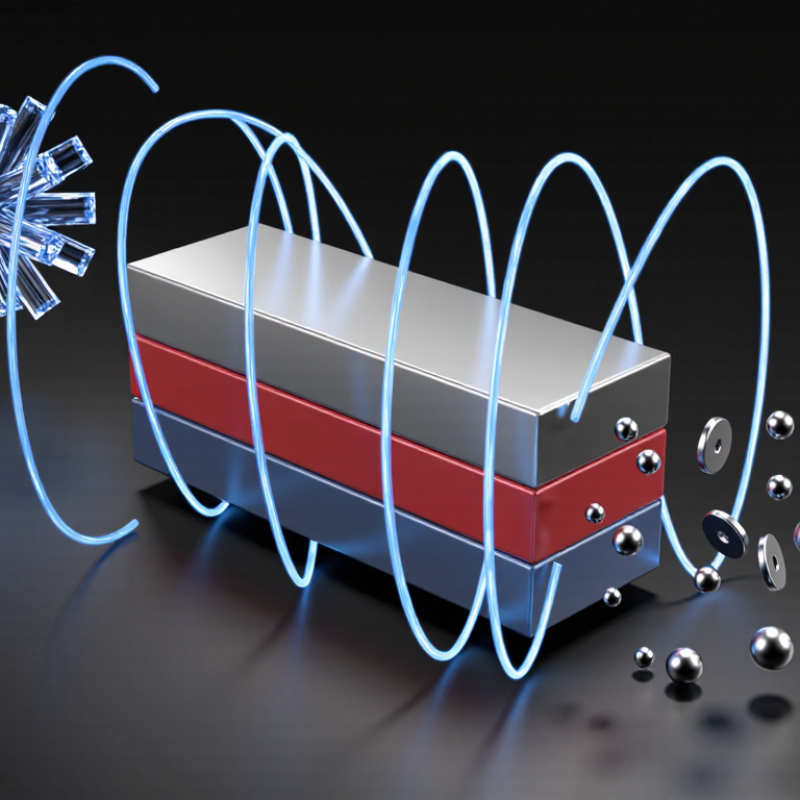
What Neodymium Magnets Are Made Of
Why Are Neodymium Magnets So Strong?
What Neodymium Magnets Are Made Of
A neodymium magnet is not a piece of pure neodymium. Its magnetic material is mainly an alloy of neodymium, iron, and boron, often written as Nd₂Fe₁₄B. The atoms form a tightly ordered crystal structure. That structure helps the magnet retain strong magnetization after exposure to a magnetic field. The iron contributes much of the magnetic force, while neodymium helps the material resist losing its magnetism. Boron helps stabilize the crystal arrangement. Small additions of other elements may be used for specific performance needs.
Making one involves more than mixing metals. Manufacturers typically process the alloy into fine powder, align the particles in a magnetic field, then press and sinter them into a dense block. The resulting material is hard and brittle, so cutting usually happens before magnetization. A thin protective coating, often nickel-based, helps limit corrosion; the shiny surface is not the source of the magnetic strength. Some grades include elements such as dysprosium to improve performance at higher temperatures, though this can affect cost and other properties. Exact recipes and processes vary. It is easy to focus on the ingredient list, but the crystal structure and careful processing matter just as much. That detail is sometimes overlooked.
How Their Atomic Structure Produces Strong Magnetism
Neodymium magnets are strong because their crystal structure makes many atomic magnetic moments work together. Their main magnetic phase, Nd2Fe14B, has a tetragonal structure. Neodymium’s 4f electrons create strong magnetic anisotropy, favoring alignment along a particular crystal direction. Iron atoms add substantial magnetic strength through interactions between their 3d electrons. Boron helps stabilize the crystal structure. It is not the main source of magnetism.
That arrangement helps a small magnet hold a steel screw firmly. But atomic structure is only part of the story. Grain size, alignment, and defects during manufacture also affect how well a magnet resists demagnetization. The U.S. Geological Survey’s Mineral Commodity Summaries 2025 estimates 2024 global rare-earth mine production at 390,000 metric tons of rare-earth-oxide equivalent, including 270,000 tons in China. Those figures describe raw-material production, not magnet output or strength. A useful distinction. Strong magnetic performance depends on processing as well as composition, and the exact contribution of each factor can be hard to separate in a finished magnet.
How Crystal Structure Helps Preserve Magnetic Alignment
Why Are Neodymium Magnets So Strong?
Neodymium magnets are powerful because their atoms and crystal structure work together. In Nd₂Fe₁₄B, iron contributes strong magnetization, while the crystal’s tetragonal structure favors one direction of magnetic alignment. This property, called magnetocrystalline anisotropy, makes the aligned state harder to disrupt. The U.S. Department of Energy’s 2022 Rare Earth Permanent Magnets Supply Chain Deep Dive Assessment describes NdFeB as a leading high-performance permanent-magnet material; high-grade examples can reach energy products around 400 kJ/m³. That matters.
Inside a magnet, many tiny regions called magnetic domains must point largely in the same direction. A well-oriented crystal structure helps resist reversal, much like grooves help keep a sliding piece on a chosen track. Yet structure alone is not the whole story. Grain boundaries, manufacturing, and heat affect how well alignment lasts. This explanation is useful, but incomplete: real magnets can lose performance when overheated or damaged.
Tips: Keep magnets away from high heat, and avoid striking them against hard surfaces. For a real application, check the magnet’s temperature rating and grade, not just its size.
How Manufacturing Shapes Their Magnetic Performance
A neodymium magnet’s strength begins with its alloy, but manufacturing determines how much of that potential survives. Producers combine neodymium, iron, and boron, then melt and refine the materials under controlled conditions. Small changes in composition can affect coercivity, temperature stability, and resistance to demagnetization. The recipe matters.
The alloy is crushed into fine powder and pressed in a magnetic field. This step encourages tiny crystal grains to point in a common direction, creating the magnet’s preferred axis. The compact is then sintered at high temperature, joining the grains into a dense solid. Density and grain structure matter: pores, uneven alignment, or impurities can reduce performance. The process is precise, though not perfectly forgiving.
After sintering, the brittle block is cut or ground to its final dimensions. Even a thin layer of material removed from an edge can change a small magnet’s measured pull. Protective coatings help limit corrosion, while final magnetization exposes the finished part to a strong field. Manufacturers also test dimensions and magnetic output, since two magnets with identical shapes may behave differently. A practical detail: the coating and geometry influence how a magnet performs in an assembly, not just its alloy grade. Manufacturing controls much, but heat, spacing, and the steel it attracts still affect real-world results.
Why Are Neodymium Magnets So Strong?
Typical maximum energy product ranges for sintered NdFeB magnet grades
Maximum energy product indicates how much magnetic energy a magnet can store. Higher grades typically achieve higher values through controlled alloy composition, powder processing, magnetic-field alignment, sintering, and heat treatment. Actual performance varies with the specific material and manufacturing process.
Which Properties Set Them Apart From Other Magnets
Why Are Neodymium Magnets So Strong?
Which Properties Set Them Apart From Other Magnets
Neodymium magnets stand out for their high magnetic energy density: a small block can produce a strong field. Typical engineering data place their maximum energy product around 200–440 kJ/m³, compared with roughly 20–40 kJ/m³ for ferrite magnets. These ranges vary by grade. The European Commission’s Joint Research Centre identifies NdFeB magnets as key materials in high-performance technologies (Critical Raw Materials for Strategic Technologies and Sectors in the EU, 2020).
That matters.
Their advantage comes from more than strength alone. High remanence helps them retain strong magnetization, while coercivity helps resist demagnetization. But heat can reduce performance, and corrosion can damage uncoated material. A compact magnet may feel surprisingly powerful between your fingertips; its pull also changes with shape, air gap, and the steel nearby.
One caveat: headline figures can make magnet choice seem simpler than it is. IEC 60404-8-1 provides a framework for classifying permanent-magnet materials, but real operating conditions still matter.
Tips: Check the grade’s temperature rating and coating, not just its pull force. Measure the gap in your actual assembly; even a thin spacer can noticeably weaken attraction.